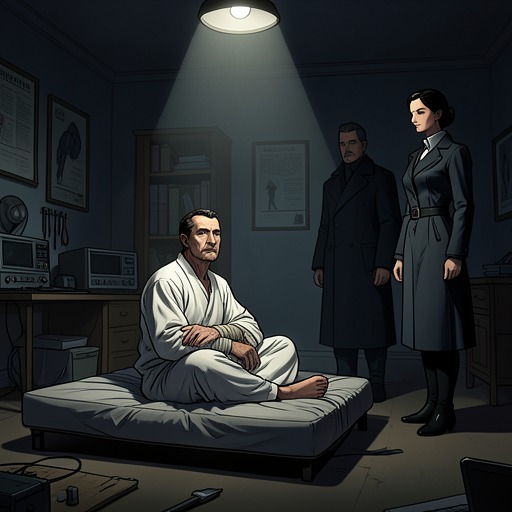
Oscar Banes opname in het Bellevue
Kay ScarpettaOscar Bane’s admission to the Bellevue forensic-psychiatric unit becomes the first major setting in which his grief, bodily vulnerability, legal anxiety, and need to direct the investigation converge. He enters not simply as a suspected participant in Terri Bridges’s death, but as someone who tells Kay Scarpetta that institutional confinement is the safest place available to him. His account makes the admission both an act of self-preservation and a strategic effort to secure Scarpetta as a witness, protector, and medically bound confidante.
Causes and Background
Oscar’s decision follows his discovery of Terri’s body. He tells Scarpetta that the person he cared about most is gone, that his life has been destroyed, and that he may as well die. He says he quickly recognized that he might be a danger to himself, while denying that he posed a danger to anyone else. By presenting the crisis in those terms, he gives the police a reason to take him to a psychiatric facility while defining the facility as somewhere he has chosen for safety rather than as proof of guilt or madness.
The admission is also shaped by Oscar’s accusation against Jaime Berger. He insists that Berger is responsible for Terri’s absence and refuses to cooperate until Scarpetta examines him. His anger is complicated by an acknowledgment that Terri was the victim: Benton Wesley admits being furious at Terri, then recoils from the unfairness of that response, since she had not asked to be harmed and had reasonably allowed a longtime friend to enter when he was drunk and disoriented. Oscar’s grief therefore enters a larger conflict over blame, desire, and the ways a victim’s relationships can be used to redistribute responsibility.
What Happens at Bellevue
At Bellevue, Oscar is physically examined while restrained. Scarpetta records his height as one meter twenty-seven, his weight as fifty-five kilograms, and his unusually small shoe sizes; she measures his arms and legs and observes that his legs are only five centimeters longer than his arms and slightly bowed. The quiet clang of the restraints and the effort of his muscles make the examination an encounter with a body that the surrounding institution has already turned into evidence.
Oscar demands that Scarpetta explain why she was summoned. He says he required Jaime Berger to understand that he would not cooperate until Scarpetta arrived, then breaks down while blaming Berger for Terri’s death. He describes himself as a victim, says he has no one left, and claims that the staff laugh at him and call him the dwarf murderer. He believes the police lack a valid reason to arrest him but suspect him of being mentally disturbed and want to prevent his escape.
He further emphasizes that he has money and a passport and comes from a good family in Connecticut, although he describes his parents as unkind. These details allow him to portray himself as capable of flight while also insisting that his despair is genuine. He has requested a private room because he cannot tolerate being among other people, and he tells Scarpetta that he has said he could harm himself. The admission thus holds two contradictory meanings at once: it is protective confinement for a frightened man, and a form of custody imposed on someone the police do not yet know how to classify.
Control of Disclosure and Examination
Oscar attempts to shape the legal meaning of every conversation. Scarpetta advises him to obtain a lawyer, explaining that statements made to counsel would be confidential. Oscar counters that medical discussions are confidential as well, that the police should not control his treatment, and that information should not be released without his consent or a court order. Scarpetta responds that a prosecutor or defense attorney may request her report if her patient is accused of a crime, warning him that anything he says may ultimately be subject to disclosure.
His insistence on Scarpetta’s presence extends beyond ordinary consent to examination. He has permitted Benton Wesley to conduct a psychological evaluation only on the condition that Scarpetta examine his body. He says Wesley may investigate his mind, but Scarpetta must investigate his physical condition, and he demands that the two doctors keep their conversations separate. He also wants Scarpetta to see his apartment, arguing that it will show how he is forced to live and that he has nothing to hide.
Oscar casts Scarpetta as more than a physician. He says she must protect him, watch over him wherever he goes, and recognize that any harm coming to him might not be accidental. He asks her to become his witness and promises that he will rely on her knowledge of who he is. His appeal places medical confidentiality, professional duty, and personal loyalty under pressure: he wants the protection of the doctor-patient relationship while also seeking an advocate who will believe him and fight for him if he is falsely accused.
Consequences and Aftermath
The Bellevue admission gives Oscar temporary physical security but does not resolve the suspicion surrounding him. It allows him to remain separate from other prisoners and to control access to his body and testimony, yet it also places him inside a forensic-psychiatric system where his statements, behavior, and physical difference can all be interpreted as signs of pathology. His claim that he is safe only under institutional protection therefore deepens, rather than settles, the question of whether he is a vulnerable witness, a suspect manipulating the terms of inquiry, or both.
The wider investigation complicates Oscar’s self-presentation. Scarpetta reconstructs Terri’s restraint and assault from the clothing left in the bathtub: the robe had been cut open from collar to cuffs, the bra straps had been cut, and the evidence suggested that Terri’s wrists were already bound behind her when she was undressed. Yet laboratory testing finds no sperm in the swabs, and the DNA results do not support sexual intercourse, even though Scarpetta considers that sexual abuse may have been intended. The distinction between intended violence and completed intercourse becomes crucial to the case, because the absence of biological evidence does not erase the assault.
A recording later shows Mike Morales threatening Terri while staging their familiar sexual dynamic as a deadly performance. Terri cries and pleads to be released while pretending that the encounter is still a game; Morales tells her that what happens is her fault. This scene exposes how intimacy, dominance, coercion, and victim-blaming can be made to resemble one another from the outside. It also casts Oscar’s Bellevue narrative in a harsher light: his insistence that Terri’s death has destroyed him exists within a story where several men attempt to define women’s suffering according to their own desires and grievances.
Significance
Oscar’s admission is significant because it turns the psychiatric ward into a contested space of testimony. He seeks sanctuary there, but he also tries to make Scarpetta the guarantor of his innocence and the keeper of his secrets. His small, restrained body invites compassion, while his precise demands about access, evidence, confidentiality, and future danger reveal an intense struggle for control. The event therefore refuses a simple opposition between illness and calculation.
The admission also anticipates the novel’s broader exposure of false identities and retaliatory narratives. Terri had written vicious anonymous columns portraying Scarpetta as weak and blameworthy, while later information shows that Terri had used a false correspondence and arranged for the columns to be sent after her death. Her hatred grew from the belief that Scarpetta, her heroine, had humiliated and rejected her. Against this network of projection and impersonation, Oscar’s demand to be seen by Scarpetta becomes an unstable act of recognition: he wants the famous forensic doctor to see his actual body, validate his suffering, and confirm an identity that the police and the public have already begun to replace with a sensational label.